
This page includes affiliate links. If you buy through them, we may earn a commission, at no extra cost to you. As an Amazon Associate I earn from qualifying purchases. See our affiliate disclosure. We do not accept payment for rankings.
This article is general information, not veterinary advice, and is not a substitute for professional veterinary care. If your animal is in pain, distressed, or showing sudden changes in eating, drinking, toileting, or behaviour, contact a veterinarian promptly.
We have not independently laboratory-tested these fountains. Capacities, noise figures, materials, and cleaning guidance below come from official product pages we fetched on 29 November 2026. A fountain is not a treatment for urinary or kidney disease.
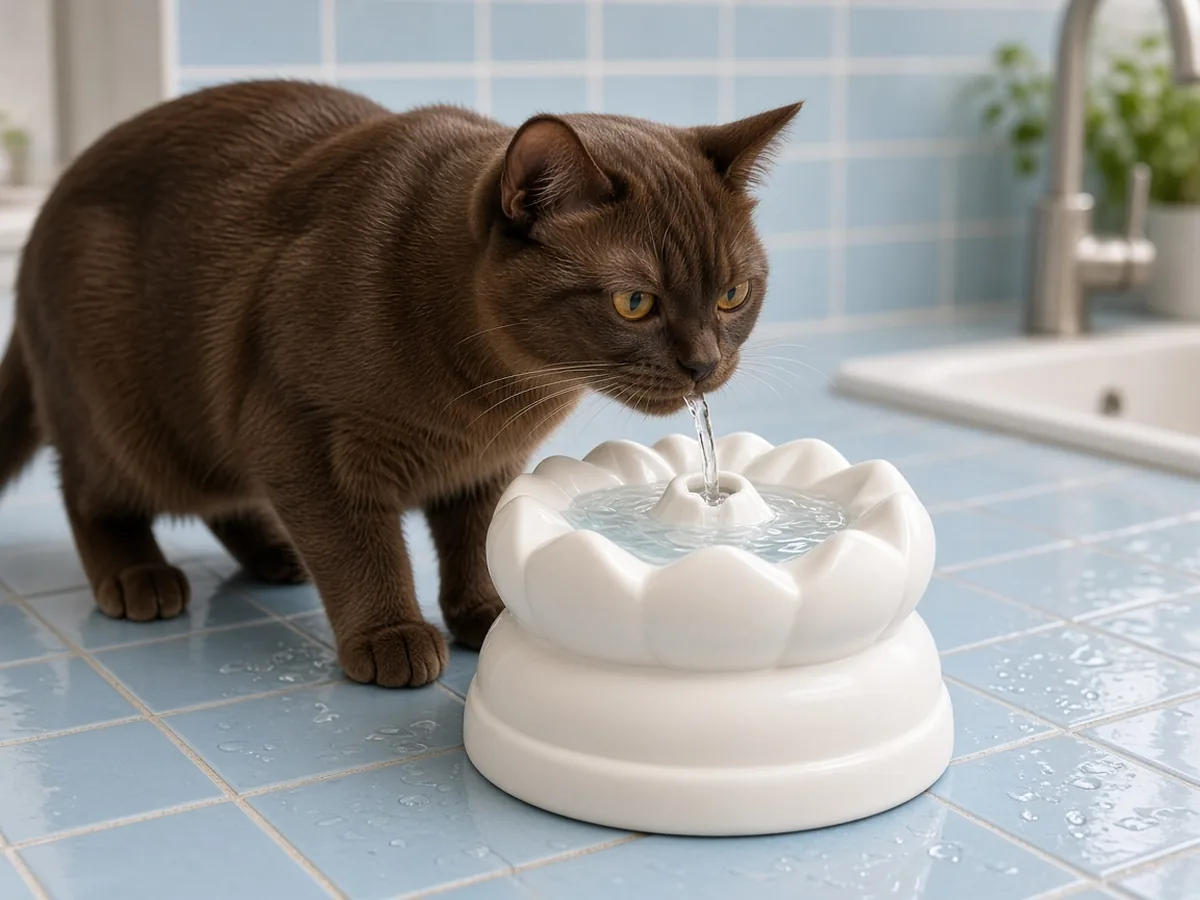
If this is your first cat in a city apartment, a simple heavy bowl of fresh water is already a good start. A fountain is an optional next step: a small recirculating pump (or a pump-free rotor) that keeps water moving, which some cats find more interesting than a still dish. In a compact, air-conditioned flat — especially in a warm, humid city — a neglected bowl also goes stale and dusty faster than you might expect.
Choosing the best cat water fountain for apartments comes down, in practice, to small-home questions, not technical ones. How loud is it at night, when you and your neighbours can hear every hum? How much water leaves the tray as splash? How many pieces do you have to clean in a small sink? Does the cable cross a hallway or a chew zone? Can you lift the tank without soaking the floor? And does the plug match your city’s sockets?
This guide is written for new owners. It compares three current fountains that fit most apartment situations: a simple 3 L steel-top fountain with no app, a compact 2 L plug-in model with Bluetooth control, and a 3 L pump-free fountain that can also run on a battery. All three are officially aimed at cats, and the two “smart” models also mention small dogs. You do not need the app-connected model first.
A fountain is still just a way to offer fresh water. If your cat is drinking much more or much less than usual, straining to urinate, or seems unwell, that is a veterinary problem, not a reason to buy a more expensive pump.
Who this is for
A fountain is worth considering if your cat already drinks from a bowl, you are willing to clean a machine every few days — in the first year, that usually means a weekly full wash and a frequent top-up — and you have a mains socket (or a well-defined plan for a cordless model) away from the litter box. If you have just brought a kitten or an adult cat home, keep a backup bowl down during the first week so the new machine is not the only water source.
You may want to stay with a heavy ceramic bowl, or speak with a veterinarian first, if:
- you are not prepared to rinse, descale, and change filters on a schedule
- the only floor space sits beside the litter tray or in a doorway
- your building’s sockets are scarce, and a battery model’s official run-time does not match how you actually use it
- you hope a fountain will treat a urinary condition on its own
Running water can interest some cats, and a clean reservoir is easier to keep appealing than a neglected bowl. That is not the same as a medical claim.
What actually matters in a small home
1. Can you clean it properly? Recirculated water grows a film. Official filter intervals only help if the tank, tray, and pump (or rotor) come apart. If a model is not dishwasher-safe, assume you are washing it by hand in a small sink.
2. How much space and noise does it add? A 20 cm-wide fountain is easier to live with than a 5 L tower. Night-time noise matters in a studio. We only quote official figures; a hard floor will still transmit some sound.
3. How much does it splash? A high flow setting, a shallow tray, or a cat that bats at the stream will put water on the floor. Official pages we opened do not give a splash measurement we can quote, so plan for a mat, start with the gentlest official flow setting, and keep the fountain off bare wood, charging cables, and a nearby feeder.
4. Plastic or stainless at the mouth? Some cats develop irritation where the chin meets a plastic rim. Catit’s official materials for the stainless-steel Flower Fountain mention touch-based sensitivity to plastic as the reason for a steel drinking surface. A steel tray is also usually quicker to wash.
5. What does “smart” actually do? An app can remind you to change a filter, or log that a single pet drank. It will not refill the tank, and tracking one animal is useless if two cats share the fountain.
6. Where does the cable go? A dangling adapter is an invitation to chew or to trip. Cordless designs solve that, at the cost of charging and, often, a higher price.
Keep the fountain well away from litter. Cats prefer not to drink next to a toilet, and you do not want litter granules in a pump. If you also use a hopper feeder, our automatic feeder guide is the companion piece; water and food can sit in the same kitchen corner, just not in the same splash zone.
Quick comparison
| Fountain | Best for | Capacity | Official size | Power | App | Dishwasher-safe parts (official) |
|---|---|---|---|---|---|---|
| Catit Stainless Steel Flower Fountain (43725) | A simple 3 L fountain with no software | 3 L | 21 × 21 × 18.5 cm | Mains adapter (regional voltages listed) | No | Stainless-steel top |
| PETKIT EverSweet Solo 2 (P4114) | A compact 2 L fountain with a wireless pump | 2 L | 185 × 185 × 164 mm | USB 5 V, 2 W; adaptor not included | Bluetooth | No — official FAQ says no parts are dishwasher-safe |
| PETLIBRO Dockstream 2 Smart Fountain | App tracking, a pump-free tank, optional cordless use | 3 L | 246 × 200 × 198 mm | Corded, or a 5,200 mAh cordless version | 2.4 / 5 GHz Wi-Fi | Stainless-steel drinking tray |
The picks
Catit Stainless Steel Flower Fountain — the simple 3 L option
If you do not want another app, start here. Official specifications are straightforward: a 3 L reservoir in a 21 cm-square footprint, a 590 g body, three flow settings (a gentle stream, a bubbling top, or calmer sheets of water), a Triple Action filter, and a backlit window so you can see when a refill is due.
The steel top is the reason it belongs in an apartment shortlist. It is officially dishwasher-safe, and Catit sells it specifically for cats that do not do well with plastic at the mouth. You still have to clean the reservoir and the pump; the steel only solves the drinking surface.
The trade-off is obvious. There is no low-water auto-shutoff described the way it is on the PIXI line, no battery option, and no intake log. You look at the window and you wash the parts. For many one-cat homes, that is a feature.
PETKIT EverSweet Solo 2 — the compact plug-in fountain
The Solo 2 is the smallest of the three, officially 185 mm square and 2 L, and PETKIT lists it for cats and small-breed dogs. A wireless pump sits in the tank without a trailing lead in the water, which makes the weekly rinse less awkward. Official noise is ≤25 dB. A transparent window shows the level, and the official FAQ says the pump shuts off if the water is too low.
The app is Bluetooth, not Wi-Fi, so you adjust modes when you are in the room rather than from the office. PETKIT’s official filter guidance is about every four weeks. The same FAQ is unusually direct about two limits: a power adaptor is not included, and no parts should go in the dishwasher. Budget for a 5 V 1 A adapter you already trust, and for washing everything by hand.
Two litres will not last a weekend if you have two thirsty cats and you forget to top up. PETKIT’s own copy says 2 L can serve one or two cats for around eight to ten days; treat that as a best case, not a plan for leaving town.
PETLIBRO Dockstream 2 Smart Fountain — pump-free, with an optional battery
The Dockstream 2 is the most “designed” of the group. Official capacity is 3 L in a 246 × 200 × 198 mm shell, with a dishwasher-safe stainless tray, 4-layer filtration, and a quoted 23 dB. Instead of a submerged pump, PETLIBRO describes a magnetic rotor in the tank driven from the base, so the water and the electronics stay separated. That is a genuine cleaning advantage in a small sink.
The official store sells a corded model and a cordless model (5,200 mAh). The 30-day battery figure is explicitly for one pet, in sensor-activated mode, on a full charge. If you have two cats, or you leave the water running continuously, you will charge it more often. App tracking of intake and drinking frequency is officially for one pet at a time; a second animal needs a different model in the same family (the RFID version), or you treat the log as a household total.
PETLIBRO recommends replacing the filter about every two weeks. That is a shorter interval than the Solo 2’s four-week guidance, and it is a running cost you should budget for. The payoff is a quieter, easier-to-open tank if you will actually do the work.
How to live with a fountain in a small flat
Place it where the old bowl already lives, on a mat, a few steps from food but well away from litter. Let the cat investigate it while it is off, then while it runs, before you retire the bowl. Some cats ignore a new sound for a week; some hook a paw over the lip on day one. Keep a backup bowl of fresh water during the changeover.
Wash on a rhythm you can keep: a quick daily rinse of the tray, and a full clean at least weekly, sooner in a warm, humid kitchen. Change filters on the maker’s schedule, not when the water looks unpleasant. In humid weather, biofilm and scale arrive early. If you also groom to reduce hairballs, you will put less floating fur into the intake.
Do not leave a fountain running for days without a top-up just because the tank is large. A 3 L reservoir that is half empty and uncleaned is worse than a small bowl you refresh twice a day.
Where to buy, and what to check
Start with the official product page so the model name and filter type are correct, then look for current stock on the brand’s regional store, Amazon.sg, or a pet shop in your city. We do not invent listing codes or promise that a given colour is in stock. Check the voltage and the plug (Hong Kong, Singapore, Malaysia, and many neighbouring cities use 220–240 V; some boxed adapters are region-specific). Those cities are where many of our readers live; they are not a promise that a given official store will ship there, or that the plug in the box will match. Budget for replacement filters, which are a running cost, and confirm that spare filters are actually sold where you live before you commit to a particular machine.
FAQ
Will a fountain make my cat drink more?
Some cats prefer moving water, and a clean fountain is easier to keep appealing than a dusty bowl. Makers often suggest this will increase intake. We have not measured that, and increased drinking is not automatically a health benefit you can assume. Sudden changes in thirst still belong in a conversation with a veterinarian.
Are these fountains all right for small dogs too?
PETKIT officially lists the Solo 2 for cats and small-breed dogs. PETLIBRO’s official FAQ says the Dockstream 2 can be used by small dogs, with the caveat that intake tracking is for one pet at a time. The Catit Flower Fountain is sold as a cat fountain; a small dog may still use it, but that is not its listed purpose.
How often do I really need to clean it?
More often than the marketing photos imply. Follow the official filter interval, and wash the tank and tray at least weekly — daily for the drinking surface if you can. In a closed, air-conditioned flat the machine still grows a film.
Will it splash the floor?
It can, especially on a higher flow setting or if the cat paws at the stream. We have not measured splash from these models. Use a mat, start on the gentlest official setting, and treat a wet rim or a nearby skirting board as a reason to move the fountain or turn the flow down, not as a defect you have to live with.
Do I need an app?
Only if a reminder or a one-pet log will change what you do. If you mainly want moving water and a steel tray, the Catit fountain does the job without another account.
Verdict
For most small apartments that want a fountain without software, start with the Catit Stainless Steel Flower Fountain: 3 L, a dishwasher-safe steel top, and a 21 cm footprint. If you want a smaller body and a wireless pump, and you do not mind hand-washing every part, the PETKIT EverSweet Solo 2 is the tighter daily driver — once you have a 5 V adapter. Choose the PETLIBRO Dockstream 2 when the pump-free tank and a stainless tray matter, or when a cordless, one-pet setup is the reason you are shopping.
None of these replace a bowl you are willing to wash, and none of them replace veterinary care if drinking or urination changes. Buy the size you will actually clean.
This page includes affiliate links. As an Amazon Associate I earn from qualifying purchases. See our affiliate disclosure.
Related guides
Best automatic pet feeders for apartment homes
A comparison of apartment-friendly automatic feeders — PETLIBRO, PETKIT, and the SureFeed microchip bowl — with criteria first and no invented lab tests.
Read the guide
Best cat litter for small apartments
How to choose cat litter for a small home, with an honest look at tofu pellets, corn clumping litter, odour, tracking, and why “flushable” is not a simple yes.
Read the guide
How to reduce cat hairballs at home
When hairballs are ordinary, when they need a vet, and how grooming, a fibre-focused food, and a classic lubricant gel can help at home.
Read the guide