
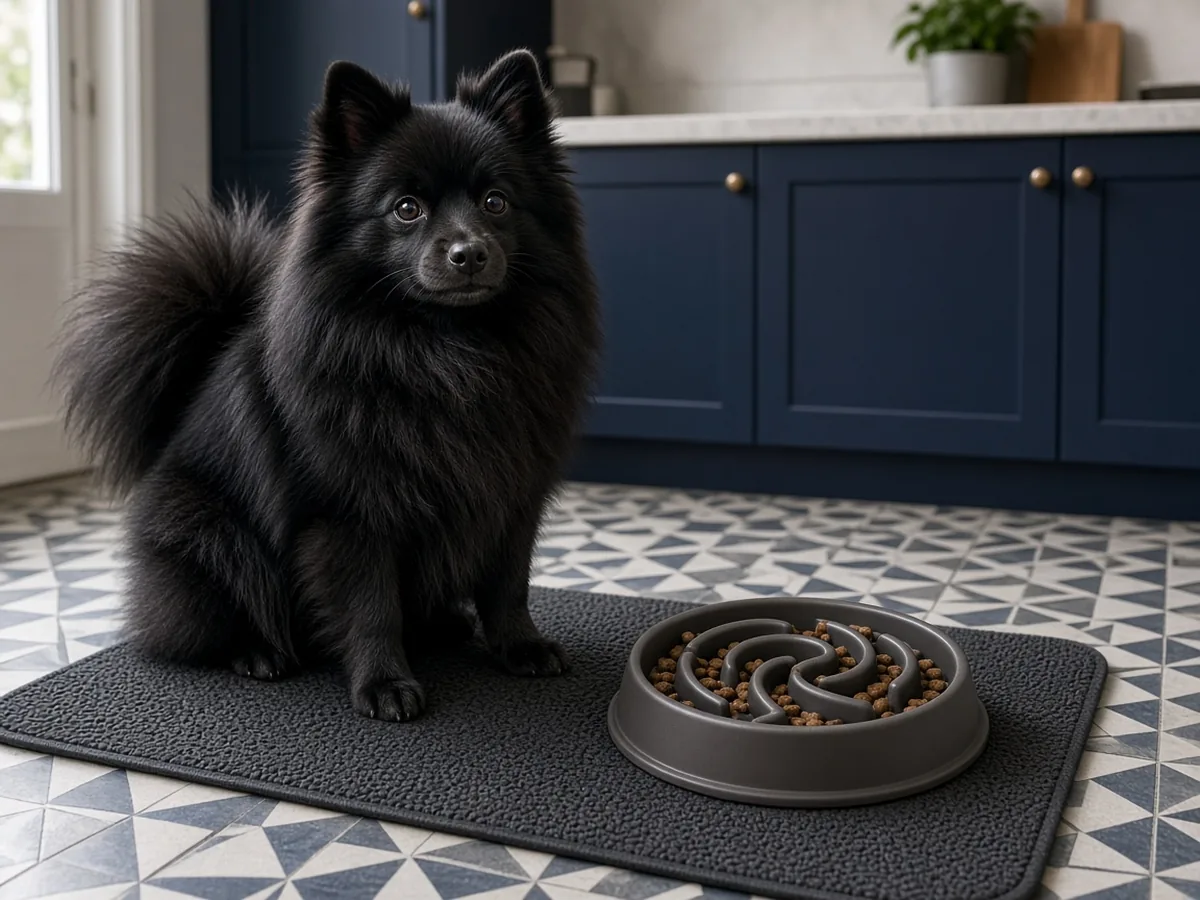
This page includes affiliate links. If you buy through them, we may earn a commission, at no extra cost to you. As an Amazon Associate I earn from qualifying purchases. See our affiliate disclosure. We do not accept payment for rankings.
This article is general information, not veterinary advice, and is not a substitute for professional veterinary care. If your animal is in pain, distressed, or showing sudden changes in eating, drinking, toileting, or behaviour, contact a veterinarian promptly.
We have not timed these feeders with a stopwatch or run feeding trials. Sizes, materials, and cleaning guidance come from official pages we fetched on 29 November 2026. Health claims about weight and bloat are discussed against veterinary sources, not manufacturer slogans alone.
If you have just brought a small dog home to a city apartment — in Singapore, Hong Kong, Malaysia, or a similar compact, humid flat — meals can disappear in a few seconds, and a short lift-and-pavement walk does not always balance a generous scoop. In a compact kitchen that is messy, noisy, and easy to overfeed by habit, a slow feeder is a shallow puzzle, not a diet. It can stretch a measured ration. It cannot fix a ration that was too large to begin with.
This guide is for first-time owners looking for the best slow feeder for small dogs. In a small kitchen, that usually comes down to bowl size, whether the dish stays put or gets picked up and skated across the floor, and the mess you then have to clean. It looks at three official designs that cover most apartment cases: a small maze bowl with a 3/4-cup official capacity (a modest scoop, not a family-sized dish), a low 20 cm plate that can hold wet and dry food at once, and a larger “grass” feeder that works for many dogs but asks for more floor. You can introduce any of these in the first weeks, using the same food your veterinarian or the feeding bag already suggested. Criteria come first; the marketing claim that a bowl makes meals “ten times slower” is noted as a manufacturer claim, not a result we have measured.
If your dog gulps, regurgitates often, or is overweight, talk to a veterinarian about the food and the portions, not only about the dish. Our guide to choosing dog food for small apartment dogs is the place to start on the ration itself.
Who this is for
A slow feeder is a good next step if your dog finishes a normal bowl in a few seconds, you already measure meals (in the first year, that usually means a jug or a kitchen scale, not a casual pour), and you can wash an extra object every day. If this is your first dog, start with the smallest official size that still holds the ration — a “large” maze sold beside it is often meant for a much bigger animal.
Think twice, or get clinical advice first, if:
- your dog destroys and swallows hard plastic
- the muzzle is so flat that deep maze walls are frustrating rather than slowing (the shallower plate in this guide is the better first try)
- you are hoping a bowl will prevent gastric dilatation-volvulus (bloat) in a deep-chested breed
- you plan to leave a stuffed feeder out all day in a warm room
Slowing a meal is useful. Unsupervised chewing of the tool is not.
What actually matters in a small home
1. Does the capacity match the dog? A “large” 4-cup maze is a serving platter for a 5 kg animal. Start with the official volume, then see whether your usual measured scoop still fits. Bowl size is the first filter, not an afterthought.
2. How much floor does it occupy? In a galley kitchen, a 15 cm bowl disappears; a 40 cm grass feeder does not. Measure the mat, not just the cupboard.
3. Will it stay put, or will the dog pick it up? A light bowl on tile can skate, tip, or be carried into another room. A non-slip base, a mat against a wall, and a lower, heavier plate all help. Official pages we opened do not rate “pickup resistance,” so this is a fit-and-behaviour check, not a lab score.
4. Wet, dry, or both — and what mess is left? Deep ridges hold kibble well and can be awkward for gravy. A divided plate is more forgiving if you use a wet topper, which is common in humid cities where dry food is mixed at the last minute. The mess that matters in a small kitchen is usually scattered kibble, a wet rim, and leftover fat in the maze.
5. Can you wash it properly? Official dishwasher-safe labels help, but a daily rinse still matters. In a warm flat, leftover fat in a maze turns rancid quickly.
6. What will it not do? The American Animal Hospital Association discusses slow feeders as one tool in a weight-loss plan, alongside a veterinary feeding plan and measured portions. On bloat, the picture is more cautious: some research has associated very fast eating with higher risk in large and giant breeds, but the evidence is mixed, and no bowl is a prevention plan. If bloat is a concern for your dog, that conversation belongs with a veterinarian.
A slow feeder also does not replace the schedule on an automatic hopper. If you use both, the hopper still has to be programmed with the same daily calories, then served into the slow bowl if you want the slowing effect.
Quick comparison
| Feeder | Best for | Official size | Official capacity / use | Cleaning (official) |
|---|---|---|---|---|
| Outward Hound Fun Feeder Slo Bowl (small) | Most small apartment dogs on a modest dry or wet ration | 15.2 × 13.9 × 2.5 cm (small) | 3/4 cup in the small size; medium holds 2 cups, large 3–4 cups | Top-rack dishwasher-safe |
| LickiMat Slomo | Wet and dry on one plate; flat-faced dogs; small kitchens | 20 × 20 × 1.7 cm | Shallow plate, not a deep bowl; also officially suitable for cats | Dishwasher-safe; freezer- and microwave-safe |
| NORTHMATE Green | A more physical “foraging” meal if you have the floor | 40 × 29 cm, 5–10 cm high, 728 g | One size; dry or wet; outer edge holds about 0.4 L of water | Dishwasher-safe, phthalate-free hard plastic |
The picks
Outward Hound Fun Feeder Slo Bowl — start with the small size
This is the familiar maze bowl, and the official small size is the one that makes sense in most apartments: 3/4 cup, 15.2 × 13.9 × 2.5 cm. That is a full meal for many toy and small breeds, not a suggestion to buy “large so there is room.” Medium (2 cups) and large (3–4 cups) exist for a reason; they belong to bigger dogs, or to households that formally feed a larger measured volume.
Outward Hound says the ridges can stretch a meal by up to ten times, and that slower eating “helps reduce obesity and bloat.” Those are the maker’s claims. We have not timed a beagle with a stopwatch. What we can say from the official specification is more modest and more useful: the small bowl is compact, top-rack dishwasher-safe, made from food-safe plastic officially free of BPA, PVC, lead, and phthalates, and it has a non-slip base. For a terrier who vacuumed a standard bowl, that is usually enough of a change.
If your dog’s face is very flat, try the bowl in person if you can, or look at the shallower Slomo first. Deep mazes are not automatically kinder to a short muzzle.
LickiMat Slomo — wet and dry, almost no height
The Slomo is a 20 cm plate only 1.7 cm high, officially designed so you can serve wet and dry food on the same surface without turning the meal into a single slurry. That is practical in a small kitchen: one object, a mat underneath, and very little tipping. Official materials say it is food-grade TPR on a recyclable polypropylene base, dishwasher-safe, freezer- and microwave-safe, and free of BPA, PVC, phthalates, and silicone. The company designed it in Australia.
LickiMat also positions the plate for short, flat-nosed dogs that struggle with taller maze walls, and says it is suitable for cats. If you share a flat with both, do not assume they will take turns politely; this is still one plate.
Because it is shallow, it will not “hide” a large kibble ration the way a deep maze can. That can be an advantage: you see the portion. You can also spread a smear of wet food and freeze it for a longer job, which is useful on a rainy or very hot, humid day when the walk is short and you want the meal to last. Wash it the same day. A frozen mat left in a warm room is a food-safety problem, not enrichment.
NORTHMATE Green — a foraging tray, if you have the floor
The Green is the most distinct design of the three: a one-piece “tuft of grass” with 43 rounded blades, officially 40 × 29 cm and 728 g. You scatter the ration into the blades and the dog has to nose and paw it out. Northmate says it is a one-size feeder for all dogs, works with dry or wet food, and has a raised edge that can hold wet food or about 0.4 L of water. It is officially phthalate-free hard plastic and dishwasher-safe.
The honest apartment caveat is the footprint. Forty centimetres is a serious claim on a galley floor. If the only free rectangle is a 30 cm mat beside the fridge, this is not your bowl. If you have a slightly more open corner, and you want a meal that feels more like a hunt than a maze, it is a well-documented option from a specialist maker, not a nameless gadget.
Supervise early sessions. Some dogs learn the game in a minute; some try to chew the blades. The hardness that makes it dishwasher-safe is not a licence to leave it with a determined chewer.
How to introduce a slow feeder
Use the same food, the same measured scoop, and the same place you already feed. If the new texture causes frustration, mix a few pieces on a flat plate beside it for the first meals, then move everything into the maze. Do not add food to “make up for” a slower meal; the point is the same calories, stretched.
Wash daily, and more often with wet food, especially in humid weather. Check that rubber feet still grip on tile. If you have two dogs, feed them apart — a slow feeder does not cancel resource-guarding.
Where to buy, and what to check
Use the official size chart first, especially where capacity is listed in cups: 3/4 cup is a small-dog portion, not a suggestion to buy the large model “for later.” Then look for stock on the maker’s site, Amazon.sg, or a neighbourhood pet shop in your city — some shops will let you see the depth of the maze, which helps if your dog has a short muzzle. We do not invent listing codes, and we do not treat Singapore, Hong Kong, or Malaysia as a promise of local stock. In a humid kitchen, prefer a design you can wash the same day, and skip any feeder your dog can break into swallowable pieces.
FAQ
Will a slow feeder help my dog lose weight?
Only as part of a plan that already controls calories. AAHA’s public weight-loss guidance treats slow feeders as a supporting tool, not as the plan itself. Measure the food, agree the target with a veterinarian, and use the bowl to stop the meal vanishing in three seconds.
Can a slow feeder prevent bloat?
Do not count on it. Bloat (GDV) is a medical emergency, mainly discussed in large, deep-chested dogs. Research on eating speed and GDV is mixed. A slow feeder may reduce gulping and regurgitation; it is not a substitute for veterinary advice, and it does not make a high-risk breed safe to leave with a huge meal.
Are these all right for puppies?
A shallow, officially food-safe bowl can be used if the puppy can reach the food without straining or chewing the ridges to pieces. Portions still follow the food’s feeding table and your veterinarian’s advice. Supervise.
What if my dog just tips the bowl?
Look for a non-slip base, feed on a mat against a wall, or switch to a heavier or lower design such as the Slomo. If tipping is a sport, a slow feeder alone will not end it.
Verdict
For most small apartment dogs, start with the Outward Hound Fun Feeder Slo Bowl in the small size: 3/4 cup, a 15 cm-class footprint, and a straightforward wash. Choose the LickiMat Slomo if you serve wet and dry together, you have a flat-faced dog, or you want almost no height on the floor. Choose the NORTHMATE Green only after you have measured a 40 × 29 cm space and you want a more physical foraging meal.
The best slow feeder is the one that fits the ration you already decided on, and that you will actually clean. The dish is the last decision, not the first.
This page includes affiliate links. As an Amazon Associate I earn from qualifying purchases. See our affiliate disclosure.
Related guides
How to choose dog food for small apartment dogs
How to choose small-breed dog food for apartment life: portions, WSAVA-style questions, and complete diets from Royal Canin and Hill’s.
Read the guide
Best automatic pet feeders for apartment homes
A comparison of apartment-friendly automatic feeders — PETLIBRO, PETKIT, and the SureFeed microchip bowl — with criteria first and no invented lab tests.
Read the guide
How to keep dogs cool in hot, humid weather
How cooling mats, water beds, and evaporative vests work in humidity, plus practical heat safety for apartment dogs. Dated official prices included.
Read the guide