
This page includes affiliate links. If you buy through them, we may earn a commission, at no extra cost to you. As an Amazon Associate I earn from qualifying purchases. See our affiliate disclosure. We do not accept payment for rankings.
This article is general information, not veterinary advice, and is not a substitute for professional veterinary care. If your animal is in pain, distressed, or showing sudden changes in eating, drinking, toileting, or behaviour, contact a veterinarian promptly.
We have not load-tested these products in a laboratory or installed them in a test flat. Dimensions, materials, load ratings, and installation notes come from official pages we fetched on 29 November 2026. Wall fittings must match your actual wall; if you are unsure, ask a qualified installer.
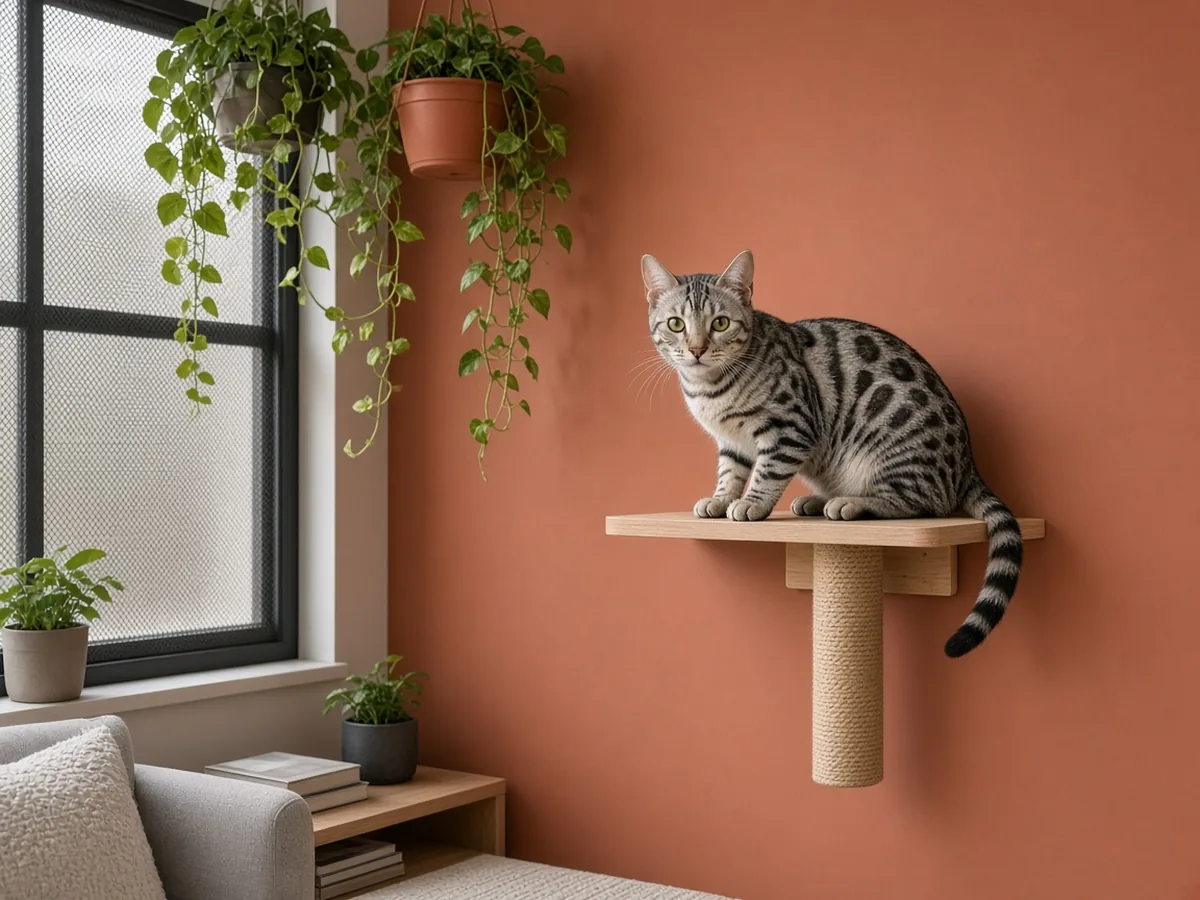
If this is your first cat in a high-rise — in Singapore, Hong Kong, Malaysia, or a similar compact city apartment — it is easy to assume a large, carpeted tower is a required purchase. In a small flat the more useful idea is simpler: a route up. The best cat tree for small apartments is usually the one whose height and footprint fit the corner you actually have, not the tallest model in the shop. A run of wall shelves is the usual alternative when the floor is already full. Cats use height to rest, watch, and step away from a busy room — or from a dog. The 2013 AAFP and ISFM Feline Environmental Needs Guidelines, still a standard veterinary-behaviour reference, recommend elevated resting places as part of a healthy indoor environment, wide enough for a cat to stretch, and reachable by kittens and less mobile cats, with a ramp or intermediate step if a single leap is too far.
This guide is a measure-first comparison, written for new owners in compact Asian city homes: Catit’s smallest Vesper floor tree, at 84.5 cm high and 56 cm square, and MYZOO’s Lack wall steps, sold in pairs and measured in the 20–30 cm range. A taller Vesper is listed for context if you have the ceiling and the floor. We leave out the 180 cm-class towers that only look reasonable in a much larger room, and we treat rental rules and partition walls as normal constraints, not afterthoughts.
If scratching or hair in the coat is already a daily issue, a tree with a sisal or seagrass post can help, but it does not replace grooming. See our guide to reducing hairballs at home for that side of the routine.
Who this is for
You will get the most from a compact tree or a short run of shelves if you can spare a corner or a structurally sound wall, and you are willing to assemble furniture carefully — or to pay someone to fix shelves into a stud. A new kitten or a newly adopted adult will often need a few days to try a tree; placing it near a window the cat already likes is more useful than buying the tallest model in the shop.
Pause, or get help, if:
- you are renting and cannot make holes without a written agreement
- the only wall is a hollow partition whose studs you cannot find
- your cat is older, arthritic, or recovering from surgery and cannot make the jumps you have in mind
- you have two cats and only one narrow path, with no way around a bottleneck
Vertical space is for the cat. It should not block your only escape route to the door, or the way to the litter box.
What actually matters in a small home
1. Measure the floor, the ceiling, and the wall. Write down width, depth, and height, including skirting boards and window sills. A 56 cm-square tree is modest until it sits beside a drying rack.
2. Prefer two ways up, not one tall leap. The AAFP/ISFM guidance is explicit that raised resting places should be accessible to less athletic cats. A mid-height step or a second shelf is not decoration.
3. Know your wall. Concrete and brick take different fixings from plasterboard. MYZOO’s official Lack notes say to reinforce where you can, to screw into a stud on a hollow wall, or to use a suitable anchor, and to ask a professional if you are unsure. That is the correct level of caution. A shelf that comes out of the wall is worse than no shelf.
4. Look for a hide as well as a perch. A cubed den with two openings — as on the Vesper Base — lets a cat retreat without feeling trapped. A bare plank is a lookout, not a hide.
5. Plan for wear. Scratching is normal. Replaceable sisal, seagrass, or cushions extend the life of a compact tree. Wooden shelves will scuff; MYZOO’s official care notes for the Lack steps say not to wash them under running water, and that surface wear can occur in use.
Keep food, water, and litter on different paths if you can. A fountain under a shelf is convenient only if splashes will not ruin the wood.
Quick comparison
| Product | Type | Official size | Official capacity / load | Best for |
|---|---|---|---|---|
| Catit Vesper Base (52042 / 52062) | Floor tree, 3 levels | 84.5 × 56 × 56 cm | Compact household; hideaway plus two lookouts | A self-contained corner tree that still leaves most of the room free |
| Catit Vesper High Base (same official series) | Floor tree, 4 levels | 121.5 × 56 × 56 cm | Same 56 cm footprint, more height | If the ceiling and a stable stance allow it |
| MYZOO Lack steps (pair) | Wall-mounted steps | S: 20 × 25 × 10 cm; M: 30 × 30 × 10 cm | About 15 kg, depending on orientation | Adding a route without giving up floor |
The picks
Catit Vesper Base — the compact floor tree
Catit calls the Vesper Base the most compact tree in that series, and the official numbers support the claim: 84.5 cm high, 56 cm on each side, three levels, a cubed hideaway with two entrances, and two lookout platforms. Cushions are memory foam. Scratching is handled by seagrass posts and a sisal mat. The structure is MDF with a walnut- or oak-look laminate, and official copy makes a point of replaceable parts and hook-and-loop cushions you can lift off to clean.
That combination is what you want in a small household: a hide, a view, and a legal place to scratch, without a 150 cm spire. Assembly uses the included hex key. The laminate is officially described as smooth enough not to collect hair the way fabric towers do — helpful, even if you will still vacuum the floor around it.
If you have the headroom and a slightly more ambitious cat, the same official page lists the Vesper High Base at 121.5 × 56 × 56 cm (four levels) and taller models still. The footprint does not grow on the High Base; the height does. Only go up if the tree cannot be pulled over, and if an older cat can still use the lower den as a main bed.
MYZOO Lack steps — vertical space that leaves the floor clear
When you cannot spare 56 cm of floor, a pair of wall steps is the more honest design. MYZOO’s Lack steps are sold as a pair on the official Japanese store, in two sizes: S at 20 × 25 × 10 cm and 0.45 kg, and M at 30 × 30 × 10 cm and 0.75 kg. The official load rating is about 15 kg, with a note that the rating depends on how the side piece is installed. Finishes are oak, white, or black; the S size is listed in oak only.
These are short, furniture-like shelves, not a complete “cat wall” in one box. You decide the spacing to match your cat’s jump, and you can add more pairs later. That is the point in a rental or a narrow hallway: start with a route from a cabinet to a window, not with a showpiece.
The non-negotiable part is the wall. Official installation guidance is unusually direct for this kind of product: reinforce the substrate if you can; on a hollow wall, fix into a stud, or use an appropriate anchor after you have judged the wall’s strength; consult a professional if you are not sure. A 15 kg rating assumes a correct fixing, not a hopeful plasterboard plug. In many Hong Kong and Singapore flats the “wall” may be a thin partition. If you cannot find a stud or a solid slab, do not improvise — use a floor tree, or hire someone who can inspect the wall.
How to set up a route in a small flat
Start where the cat already sits: a window, a bookcase, the top of a cabinet. Add a step that shortens the longest jump, then a resting shelf that is wide enough for the cat to lie on, not merely perch. Leave a way down that does not pass through a crowded worktop.
In a multi-cat home, try to offer more than one resting place at height so a confident cat cannot block the only stair. The AAFP/ISFM guidelines treat safe, raised places as resources, like food bowls and litter trays — meaning you may need more than one.
Give a new tree a week before you decide it has failed. Rubbing a little of the cat’s bedding on a cushion is more useful than dangling a toy in the cat’s face. If you have a dog, keep the lowest platform high enough, or in a corner, so the cat can leave without being cut off.
Where to buy, and what to check
Measure the corner or the wall, including skirting and window-sill depth, before you order. Then start from the official product page (Catit’s Vesper series, or MYZOO’s Japanese store for the Lack steps) and look for current stock on official regional sites, Amazon.sg, or a local pet shop that will take a return if the footprint is wrong. We do not invent listing codes, and mentioning Singapore, Hong Kong, or Malaysia as places readers live is not a promise of local stock or a particular shipping route. If you rent, get hole-drilling in writing before you buy wall steps; a compact floor tree is the easier first-year purchase in many buildings.
FAQ
Will a cat tree stop my cat scratching the sofa?
It gives a legal alternative, especially if the post is stable and the texture (sisal or seagrass) is appealing. It is not a guarantee. Place the tree near the furniture that is already being scratched, and keep using nail care and, if needed, a veterinarian or behaviourist, rather than punishing the cat.
Can I install wall shelves in a rental?
Only if your agreement allows holes, or if you can use a method your landlord has approved in writing. Some buildings also have rules about exterior-facing walls. When in doubt, a free-standing compact tree such as the Vesper Base leaves no holes behind. If the floor is already full and you cannot drill, do not force a tall tree into a doorway; wait until you have a legal fixing, or a corner that is actually free.
Are wall shelves a substitute for a cat tree?
They can be, if you build a real route: more than one step, a resting shelf wide enough to lie on, and a way down that does not end on an unsecured sill. They do not automatically include a hide or a scratching post, which is why a compact floor tree is still the simpler first buy when you can spare the footprint.
How high is too high?
High enough to feel like a lookout, low enough that your cat can arrive and leave without a crash. For kittens, seniors, and cats with joint disease, intermediate steps matter more than a dramatic top perch. If mobility is changing, ask a veterinarian before you build a taller route.
Do I need a huge tree for two cats?
Not necessarily, but you do need more than one resting place and a way past each other. Two modest platforms can be kinder than one tall, narrow tower.
Verdict
If you can spare a 56 cm corner, start with the Catit Vesper Base: a genuine hide, two lookouts, and a scratching post in a tree that is under 85 cm high. If the floor is already full, and you can fix into a sound wall, MYZOO Lack steps add a route in 20–30 cm deep increments — provided the installation matches the wall you actually have. Step up to the Vesper High Base only when the extra height is usable, not merely impressive.
Measure twice, fix shelves once, and treat height as part of the home, not as a gadget you lean in a corner.
This page includes affiliate links. As an Amazon Associate I earn from qualifying purchases. See our affiliate disclosure.
Related guides
How to reduce cat hairballs at home
When hairballs are ordinary, when they need a vet, and how grooming, a fibre-focused food, and a classic lubricant gel can help at home.
Read the guide
Best cat litter for small apartments
How to choose cat litter for a small home, with an honest look at tofu pellets, corn clumping litter, odour, tracking, and why “flushable” is not a simple yes.
Read the guide
Best cat water fountain for apartments
A practical shortlist of apartment-friendly cat fountains — Catit, PETKIT, and PETLIBRO — with noise, splash, and cleaning first, and no invented tests.
Read the guide