
Product links on this page are not affiliate-tagged, so a click does not earn us a commission. See our affiliate disclosure. We do not accept payment for rankings.
This article is general information, not veterinary advice, and is not a substitute for professional veterinary care. If your animal is in pain, distressed, or showing sudden changes in eating, drinking, toileting, or behaviour, contact a veterinarian promptly.
We have not hands-on tested these carriers in lifts, taxis, or clinics, and we have not crash-tested them. Dimensions, recommended pet weights, materials, and prices come from official product pages we opened on 29 November 2026 (Asia/Hong_Kong). Safety certifications are the makers’ claims, plus, where named, the testing body the maker cites; they are not results we produced. Public-transport rules are quoted only from an official MTR page we opened the same day; we did not verify Singapore MRT, bus, Grab, or taxi policies. This is general information, not a substitute for veterinary care.
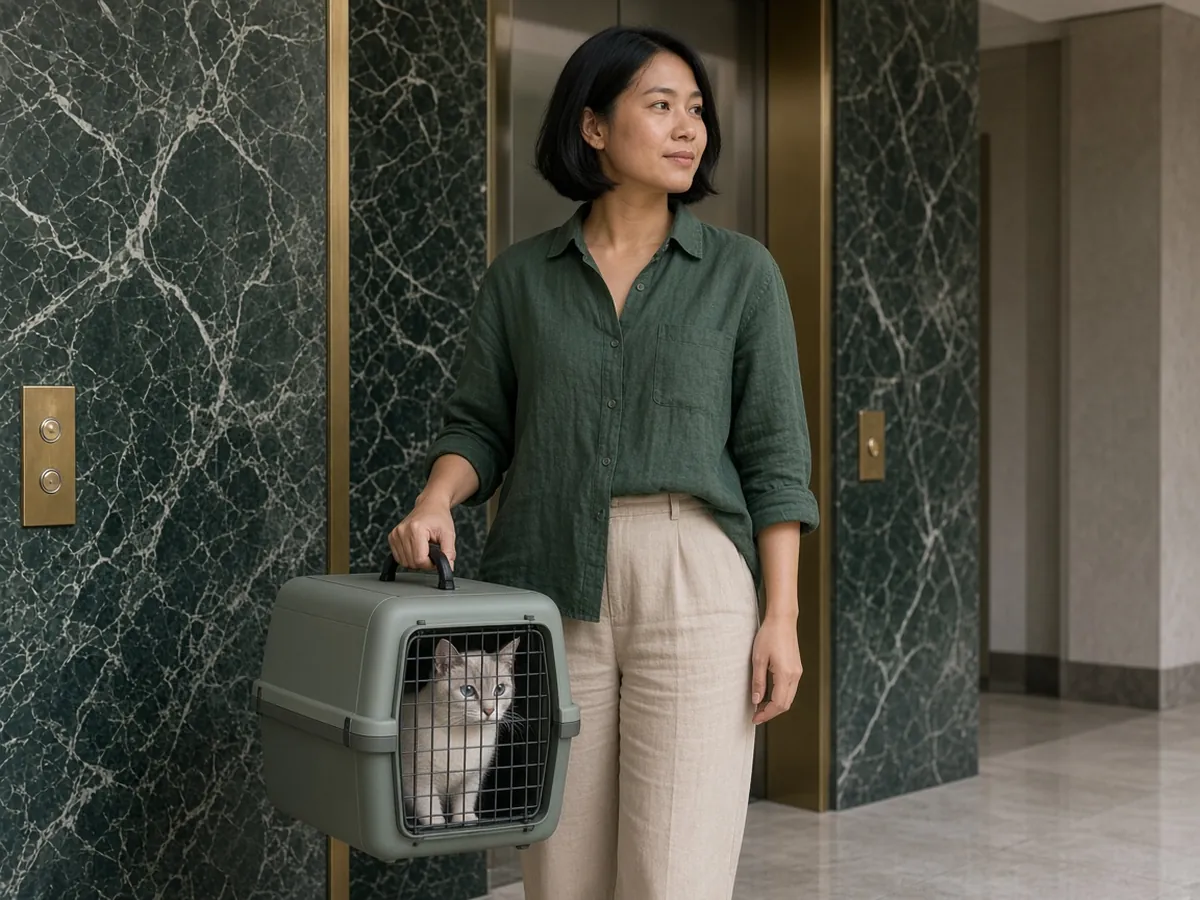
If this is your first dog or cat in a Singapore, Hong Kong, or Malaysian apartment, you will need a carrier sooner than you think. The first vet visit, a booster, a nail trim you would rather not do in the bathroom, a taxi downstairs when the animal cannot walk in. A harness is for walking. The best pet carrier for vet visits is the one you have already practised with at home, not a last-minute bag on appointment day. A carrier is for the times the animal should not be loose in a lift lobby, a back seat, or a waiting room.
For a first cat, the best cat carrier is often a hard, compact case you can carry into a lift, wipe after a taxi ride, and store in a hallway cupboard. Soft carriers and larger dog kennels still have a place, and they are covered below, but the everyday city job is the same: a secure box that fits the animal and fits your building.
The useful questions are practical. Will the animal stand, turn, and lie down? Can you carry it down a corridor and into a lift? Can it be wiped after a humid taxi ride? Does the model have a way to sit belted in a car, if you use one? And — only after that — does a given bus, rail, or airline operator even allow pets, and on what terms?
We do not treat the words “airline approved” on a product page as a ticket. Operators set their own size and booking rules, and those rules change. Confirm the current policy before you travel. For this guide we opened one official public-transport page, MTR’s Light Rail scheme in Hong Kong, and we quote that below. We did not independently verify Singapore MRT or bus rules, or Grab or taxi policies, so we do not invent them.
Who this is for
This is for a first-year owner who needs one reliable carrier for clinic visits and short city trips, and who will take a week or two to let the animal treat the box as furniture, not as a trap that only appears on injection day.
It is a good fit if your dog or cat can reasonably travel in a compact hard case or a soft bag, you can store the box in a hallway cupboard or under a bench, and you are willing to practise short sits at home before the first appointment.
Pause, or get a different plan, if:
- the animal is already too large for a carrier you can lift safely — you may need a bigger hard kennel and a second person, or a clinic that can advise on transport
- you are planning a flight and have not yet read the airline’s current cabin or hold rules
- the animal is injured, in respiratory distress, or highly distressed; ask the clinic how they want you to travel, rather than forcing a first introduction on the way
- you hoped a backpack with the animal’s head out would do for rail or a taxi — many operators, and basic road safety, want the animal fully enclosed
Hard, soft, or “the one the website called airline approved”
Hard plastic carriers are easy to wipe, they keep their shape in a lift and under a seat, and many have a top or front door you can use at the clinic without the animal bursting out. They are bulkier to store unless they collapse, and cheap latches should be checked before each trip.
Soft-sided carriers are lighter, often sit on a suitcase handle, and can be easier to tuck into a small hallway. They can sag if the base is weak, they take longer to dry in humid weather if they get wet or soiled, and a determined chewer can damage mesh. A soft bag is only as safe in a car as its tethers and its tested design — not as a loose bag on a parcel shelf.
“Airline approved” is a marketing phrase, not a boarding pass. Some makers design a bag to compress under a cabin seat and to meet common size bands. Your airline, and the agent at the gate, still decide. Measure the carrier and the animal, then read the operator’s current page.
For public transport, the same humility applies. Rules differ by city and by mode, and a carrier that is legal on one service may be banned on another.
One official example, opened on 29 November 2026 (HKT): the MTR “Cat/Dog Carrying Scheme” on Hong Kong Light Rail, described as an ongoing arrangement from 1 September 2025. On the official page, passengers may bring one cat or dog on Light Rail on Saturdays, Sundays, and public holidays after buying an electronic Cat/Dog Carrying Pass, listed at HK$99 for the calendar month. The same page states that passengers still pay the usual fare. The animal must be placed completely inside a pet-specific carrier that is fully closed or covered, with no body parts exposed; the bag should not be opened until you leave Light Rail premises. Combined carrier dimensions (length + width + height) must not exceed 170 cm, and no single side should exceed 130 cm. Wheeled pet strollers or cart-like carriers are not allowed. The same page states that other railway networks are not covered by the programme and that animals are not allowed there, excluding guide dogs and police dogs. Staff may check the pass and the bag. If you use Light Rail, read the current official page before you go; this summary is not a ticket.
Elsewhere — Singapore MRT and buses, intercity coaches, taxis and private-hire cars — check that operator. We have not quoted those rules here because we did not open official pages we could verify for this guide.
What actually matters in a city apartment
1. Measure the animal, then the box. Official guidance on the Petmate page is a useful default for hard kennels: measure from the top of the head to the floor, and from the tip of the nose to the base of the tail; the kennel should be a little taller and longer so the animal can stand, turn, and lie down. Catit’s official advice is to choose a carrier by the cat’s full-grown adult height, measured from the top of the head to the bottom of the front paws. Weight limits are a cap, not a fit. A long, low dog can be under a weight limit and still be cramped.
2. Ventilation and a secure close. Look for openings on more than one side, a door or zipper that actually latches, and a way to get the animal out at the clinic without a wrestling match in a corridor. A top opening is often calmer for cats. Check zips and clips before each trip.
3. A base you can carry, and clean. A stiff bottom so the animal does not sag in a lift; a wipeable floor or a removable, washable pad. In humid weather, a soiled soft lining needs a proper wash and a full dry — do not zip a damp bed into a closed bag and leave it in a cupboard.
4. Cars, taxis, and heat. A loose carrier on a seat can become a projectile. Prefer a model with a stated way to pass a seatbelt, or a tested car-safety design, and place it where it will not slide. Never leave an animal in a parked car or a sun-soaked taxi cabin “for a minute.” Our humid-weather cooling guide is explicit about cabin heat. Cool the cabin first, keep a short ride short, and offer water when you arrive.
5. Train at home, not in the clinic car park. Leave the carrier out, door open, with a familiar towel and occasional treats, in a quiet corner of the room — not only as the object that precedes a jab. Short, boring sits with the door closed, then a walk to the lift and back, are more useful than a last-minute chase.
Quick comparison
| Product | Type | Official size | Official pet fit | Best for |
|---|---|---|---|---|
| Catit Cat Carrier (Small / Medium) | Hard, collapsible, with a top petting door | Small: 48.3 × 32.6 × 28 cm; Medium: 56.5 × 37.6 × 30.8 cm | Small: cats up to 24 cm tall; Medium: up to 27 cm tall (head to front paws) | A first cat carrier for vet trips and short car rides, stored flat between uses |
| Sleepypod Air | Soft-sided, compresses in length; official crash-test claim | Exterior 40.64–55.88 × 26.67 × 26.67 cm (length adjusts 16–22 in) | Officially recommended for pets 18 lb (8 kg) or less; maker cites Center for Pet Safety certification to 18 lb | A lighter bag for a small dog or cat, if you also care about a stated car-safety design |
| Petmate Vari Kennel | Two-piece hard plastic kennel, several sizes | 19 in through 40 in exteriors; interiors listed below | Official weight bands from “up to 10 lb” (19 in) upward; apartment dogs often fall in the 19, 24, or 28 in sizes | A straightforward hard box, especially for dogs, that you can wipe and belt in a vehicle |
All three, at the official sizes above, sit well under MTR Light Rail’s 170 cm combined-dimension cap, if you use that service. That is a measurement check, not permission to board any other network.
The picks
Catit Cat Carrier — a hard case for most first cats
If you have a cat, and your main trips are the vet and the occasional taxi, a hard, easy-to-clean carrier with a top door is the usual first buy. You can store it collapsed in a small flat, and you can wipe it after a messy journey.
Catit’s official Cat Carrier comes in Small and Medium, each in three colours, with a side-latch door and safety lock, a top petting door, a removable food and water dish, a skid-resistant base with a collection gutter, and a top handle that the official page says can be used to loop a car seatbelt. Official measurements: Small, 48.3 × 32.6 × 28 cm (19 × 12.8 × 11 in), for cats up to 24 cm (9.5 in) tall; Medium, 56.5 × 37.6 × 30.8 cm (22 × 14.8 × 12 in), for cats up to 27 cm (10.5 in) tall. Height is measured from the top of the head to the bottom of the front paws. Official advice is to size for the adult cat, not the kitten you have this month.
The same official page tells you, correctly, to contact your public-transport service or airline for their requirements before you travel. The official Catit page opened on 30 November 2026 (HKT) still did not publish a retail price we could quote, and it did not state shipping to Singapore, Hong Kong, or Malaysia. Confirm a live listing and the exact model numbers (Small: 41380, 41381, 41382; Medium: 41383, 41384, 41385) before you buy.
This carrier is officially a cat carrier. We are not stretching it to dogs.
Sleepypod Air — a soft carrier with a stated crash-test rating
If you want one bag for a small dog or a cat, and you also care about how the bag behaves in a car, Sleepypod’s Air is the officially documented option in this shortlist. It is also the most expensive, and a soft bag still needs a dry, careful clean in a humid climate.
Sleepypod’s official page describes the Air as a carrier that compresses in length to sit under a range of airline seats, doubles as a crash-tested car seat, and can be used as a bed. Official exterior dimensions are 16 to 22 in long × 10.5 in wide × 10.5 in tall (40.64 to 55.88 × 26.67 × 26.67 cm); official interior dimensions are 15 to 21 × 9.5 × 9.5 in (38.1 to 53.34 × 24.13 × 24.13 cm). Official carrier weight is 4 lb, or 4.5 lb (2.04 kg) with the privacy shield, and 4.9 lb (2.22 kg) with the shield and shoulder strap. It is officially recommended for pets 18 lb (8 kg) or less.
The maker states that the Air has been independently crash-tested and certified with a top safety rating for pets up to 18 lb by the Center for Pet Safety, and that testing reflects U.S. child safety seat standard FMVSS 213. That is Sleepypod’s claim, citing that laboratory; we have not repeated the test and we do not treat it as a guarantee in every vehicle or every crash. Official features include mesh on four sides, a stiff bottom, a trolley pocket for a suitcase handle, a removable safety tether, a privacy panel, and machine-washable Ultra Plush bedding (wash the plush on a cold gentle cycle and line dry; do not assume the whole bag is machine-washable).
Sleepypod also calls it “the largest carrier approved for in-cabin air travel” and refers to “international airline requirements.” Those are the maker’s words. Measure the compressed bag against your airline’s current under-seat limit, and confirm with the airline. Height stays 10.5 in (26.67 cm) even when length is compressed, which is enough to miss some operators’ limits.
On 30 November 2026 (HKT), Sleepypod’s official store listed the Air at US$214.99. Confirm the live price and whether the store will ship to you; the page we opened did not clearly state shipping to Singapore, Hong Kong, or Malaysia.
Petmate Vari Kennel — a wipeable hard kennel in real sizes
For a small apartment dog, or for a household that wants a simple hard box that can also work for a cat, a two-piece plastic kennel is still the standard object. It does not collapse as neatly as the Catit, so measure the cupboard as well as the animal. It is, however, easy to rinse and dry, and the official page is unusually clear about sizes.
Petmate’s official All Purpose Vari Kennel page lists interiors as follows:
- 19 in: interior 16.2 × 12 × 9 in; official weight range up to 10 lb; product weight 3.05 lb
- 24 in: interior 21.5 × 15 × 13.5 in; 10–20 lb; product weight 5.0 lb
- 28 in: interior 24.25 × 18.25 × 19.5 in; 25–30 lb; product weight 10.0 lb
- Larger official sizes continue through 32, 36, and 40 in, up to a 70–90 lb band, which is more kennel than most compact flats can store or carry
Use the measure-the-animal method above, not the weight band alone. Official features include vents, an interior moat, a squeeze-latch door, tamper-proof holes for zip ties when travelling, and, on the 19, 24, and 28 in sizes, a multi-purpose handle “designed for both carrying and securing in a vehicle.” Larger sizes use tie-down strap holes instead. Official copy says the kennel meets most air-travel requirements if assembled with the supplied wing nuts and bolts, and — again correctly — tells you to contact the airline. The 19–28 in sizes are the realistic ones to consider in a small home; we are not suggesting a 40 in freight kennel for a studio.
On 30 November 2026 (HKT), Petmate’s official page listed labelled prices for the apartment shortlist, all shown as available in Taupe/Black: the 19 in kennel (SKU 21859) at US$39.99, for pets up to 10 lb; the 24 in kennel (SKU 21863) at US$54.99, for 10–20 lb; and the 28 in kennel (SKU 21947) at US$94.99, for 25–30 lb. Confirm the live price for the exact size and colour you need, and confirm shipping; the page did not clearly state delivery to Singapore, Hong Kong, or Malaysia.
How to introduce a carrier without a fight
Set the carrier up a week or more before the appointment, in a room the animal already uses, with the door open and a familiar towel inside. Feed a few treats in and around it. For a cat, a light cover over part of a hard carrier can make the box feel less exposed, as long as ventilation remains. Do not spray unfamiliar scent products into the box and hope; if a veterinarian has recommended a specific calming approach, follow that advice.
On the day, give yourself more time than the lift usually takes. Carry the carrier level. In a waiting room, keep it off the floor if a clinic asks you to, and do not open the door “just to comfort” the animal in a busy aisle. After the trip, wipe hard surfaces, wash what the maker says is washable, and dry everything before the carrier goes back into a humid cupboard.
Where to buy, and what to check
Start with the official product page so the size, model number, and (for Sleepypod) the current safety wording are correct. Then look for a regional brand store or a local pet shop. We do not invent listing codes or promise local stock. If you will use a specific rail, bus, or airline service, read that operator’s current pet page — including any pass, booking, or dimension rule — before you pay for a bag designed around a different country’s cabin limit.
FAQ
Can I just hold the cat in a towel, or walk the dog in on a lead?
For a city clinic trip, a secure carrier is the calmer default. Lifts, lobbies, and waiting rooms are full of surprises. A lead is for walking, as our harness guide describes, not for a loose animal in a taxi. If the animal is too large to carry, ask the clinic how they prefer you to arrive.
Will my carrier be allowed on the MRT or in a taxi?
Only the operator can answer that, on the day you travel. For Hong Kong Light Rail we have quoted the official weekend-and-holiday scheme, including the HK$99 monthly pass and the 170 cm combined-dimension cap, as of the page we opened on 29 November 2026. We have not verified Singapore MRT, bus, or taxi rules for this guide, and we will not invent them. Check before you go.
How early should I buy a carrier?
Before the first appointment, with enough days to leave it out at home. A carrier that appears for the first time in a stairwell is a much harder introduction.
Can two pets share one carrier?
Not as a default. The official products above are described for one animal. Two animals in one box can overheat, fight, or injure themselves. If a clinic or operator has a specific rule, follow that.
What if my dog or cat screams in the carrier?
Keep practising shorter, calmer steps at home, and ask your veterinarian for help if the animal panics, vomits, or cannot settle. Force is not a training plan. A different size or a top-opening hard case sometimes helps, but distress that does not ease is a clinical conversation, not a cue to buy a “calming” product at random.
Verdict
Buy a carrier you can lift, clean, and practise with at home, sized to the adult animal, before you worry about weekend rail schemes or cabin baggage. For most first cats, the Catit hard carrier is the straightforward start: two official sizes, a top door, and a wipeable base. For a small dog, or a mixed household that wants a clearly labelled hard kennel, a Petmate Vari Kennel in a measured 19, 24, or 28 in size is the more practical object. The Sleepypod Air earns its place if you need a lighter bag for a pet under 18 lb and you care about the maker’s cited crash-test certification — not because a website called it airline approved. In every case, read the operator’s current rules, keep the animal fully enclosed when that is required, and never leave a carrier in a hot parked cabin.
Product links on this page are not affiliate-tagged, so a click does not earn us a commission. See our affiliate disclosure. We do not accept payment for rankings.
Related guides
Harness vs collar for city walks
A beginner-friendly guide to harness vs collar for city walks, plus how to choose a well-fitted everyday harness — with two official options and no invented fit tests.
Read the guide
How to keep dogs cool in hot, humid weather
How cooling mats, water beds, and evaporative vests work in humidity, plus practical heat safety for apartment dogs. Dated official prices included.
Read the guide
Dog nail grinder vs clippers
A first-year comparison of a dog nail grinder vs clippers for new owners in city apartments: when nails are long, how the tools differ, and two official examples.
Read the guide