
This page includes affiliate links. If you buy through them, we may earn a commission, at no extra cost to you. As an Amazon Associate I earn from qualifying purchases. See our affiliate disclosure. We do not accept payment for rankings.
This article is general information, not veterinary advice, and is not a substitute for professional veterinary care. If your animal is in pain, distressed, or showing sudden changes in eating, drinking, toileting, or behaviour, contact a veterinarian promptly.
We have not hands-on tested these boxes in our own homes, and we have not run odour, noise, or dust tests of our own. Dimensions, weight limits, litter compatibility, and prices come from official product pages we opened on 29 November 2026 (Asia/Hong_Kong). This is general information, not a substitute for veterinary care.
If this is your first cat in a Singapore, Hong Kong, or Malaysian apartment, the box matters as much as the bag. You share the air with it. You walk past it on the way to the kettle. You carry the waste down a lift or a stairwell. Choosing the best litter box for small apartments usually means a tray you will actually scoop every day, not an expensive machine that is too big for the bathroom, too loud for a studio at night, or filled with a litter it cannot sift.
This is a box guide, not another litter guide. For tofu pellets, corn clumping litter, dust, tracking, and why “flushable” is not a simple yes, use our cat litter guide for small apartments. Keep the two decisions in that order: a quiet, reachable place and a box your cat will enter, then a litter the cat will accept.
You do not need a self-cleaning machine in the first week. Many first-time owners do perfectly well with a simple open tray, scooped daily, while the cat settles in.
Who this is for
This is for a first cat — or a newly adopted adult — in a compact city home, where the box may have to live in a bathroom, a service corridor, or a quiet corner of a studio. It assumes you will scoop, you can spare a rectangle of floor, and you would rather buy one box that fits than a catalogue of extras.
Pause, or get help, if:
- a previously tidy cat is suddenly avoiding the box, straining, or passing blood — that is a veterinary problem first, not a shopping problem
- you only have a balcony in mind, in a humid city (hot, wet, and an easy place to slip out)
- you are hoping a machine will let you leave waste for many days in a studio with no airing
- your cat is a young kitten, is recovering from surgery, or has trouble jumping, and the box you like is top-entry or has a high step
Singapore’s Animal and Veterinary Service, on its cat-care page last updated 1 October 2026 (opened 29 November 2026), states the familiar “n+1” idea for multi-cat homes: for two cats, plan on three litter boxes if you can, along with extra bowls and resting places, spread out so the cats are not forced to share a bottleneck. In a studio that may be impossible. If you only have room for one box, you have to be stricter about size, scooping, and choosing a design the cat will actually use.
What actually matters in a small home
1. Floor, entry, and the cat’s body — not the photo. Measure the space you really have, including the door swing of a bathroom and any drying rack that already lives there. Then measure the cat, or the adult size you expect: length including the tail’s base, height to the shoulder, and whether the cat likes to stand and turn around. A compact cube can be a gift in a 40-square-metre flat and a poor fit for a long or heavy cat.
2. Open, covered, or top-entry is a trade, not a ranking. Open trays ventilate, are easy to step into, and suit many cats, kittens, and older animals. They also show the box and let odour travel. High sides or a splash guard cut scatter and “high peeing,” which matters on hard floors. Covered or top-entry boxes hide the tray and can reduce tracking, because the cat walks across a lid on the way out; they also trap humidity and smell if you scoop late, and some cats will not jump or twist to get in.
3. Placement still beats plastic. Keep the box indoors, on a mat, away from food and water — including any fountain or feeder. A quiet bathroom corner usually beats a hallway that visitors walk through, a kitchen, or a balcony. The cat needs a clear path, not a performance through a slammed utility door.
4. Scooping is the odour system. In humid weather, urine clumps that sit overnight sour faster. Scoop daily at least, twice if you can. Our litter guide walks through why daily scooping is also a public-health habit, including CDC guidance on Toxoplasma. A carbon filter or an “odour” cycle on a machine is a supplement, not a licence to ignore the drawer.
5. If you want a self-cleaning box, budget the whole object. These units are large, they need a level hard floor and a socket, they make a cycle noise, they want a specific clumping litter, and they add bags, filters, and sometimes a deodoriser as running costs. Check the maker’s cat weight and age limits, the entry height, and whether the official store will actually ship to you. Official pages we opened for regional plug type and shipping to Singapore, Hong Kong, or Malaysia were not consistent, so treat those as a check at purchase, not as a promise.
6. What the cat already knows. If you have just brought a cat home, start with a box and a litter close to whatever was used before, in a quiet spot the cat can find. Change one thing at a time. If you later move to a top-entry or a machine, leave the old box down until the new one is clearly in use.
Quick comparison
| Product | Type | Official size | Official cat fit | Best for |
|---|---|---|---|---|
| Modkat Tray | Open tray with clip-on splash guard | 51.0 × 36.0 × 23.0 cm; 40.0 cm high with the guard; entry 21.0 cm wide, 16.5 cm from the floor | No official weight cap stated on the page we opened; low step-in | A first box that stays easy to enter and still has high sides |
| Modkat (top-entry) | Compact top-entry cube | 40.6 × 40.6 × 38.0 cm; 24.1 cm top opening; 25.4 cm liner height | Officially best suited to cats up to 12 lb (5.4 kg) | Tracking and a smaller footprint, if the cat can jump and turn |
| PETKIT Purobot Max 3 | Self-cleaning cylinder with a side waste bin | 62.0 × 53.8 × 55.2 cm; entrance height 20.4 cm; unit weight 10 kg | Officially for cats 6 months and older, 1.5–10 kg | Owners who have the floor, a hard surface, a socket, and a budget, and who still accept emptying and cleaning |
The picks
Modkat Tray — start here if you want an open box
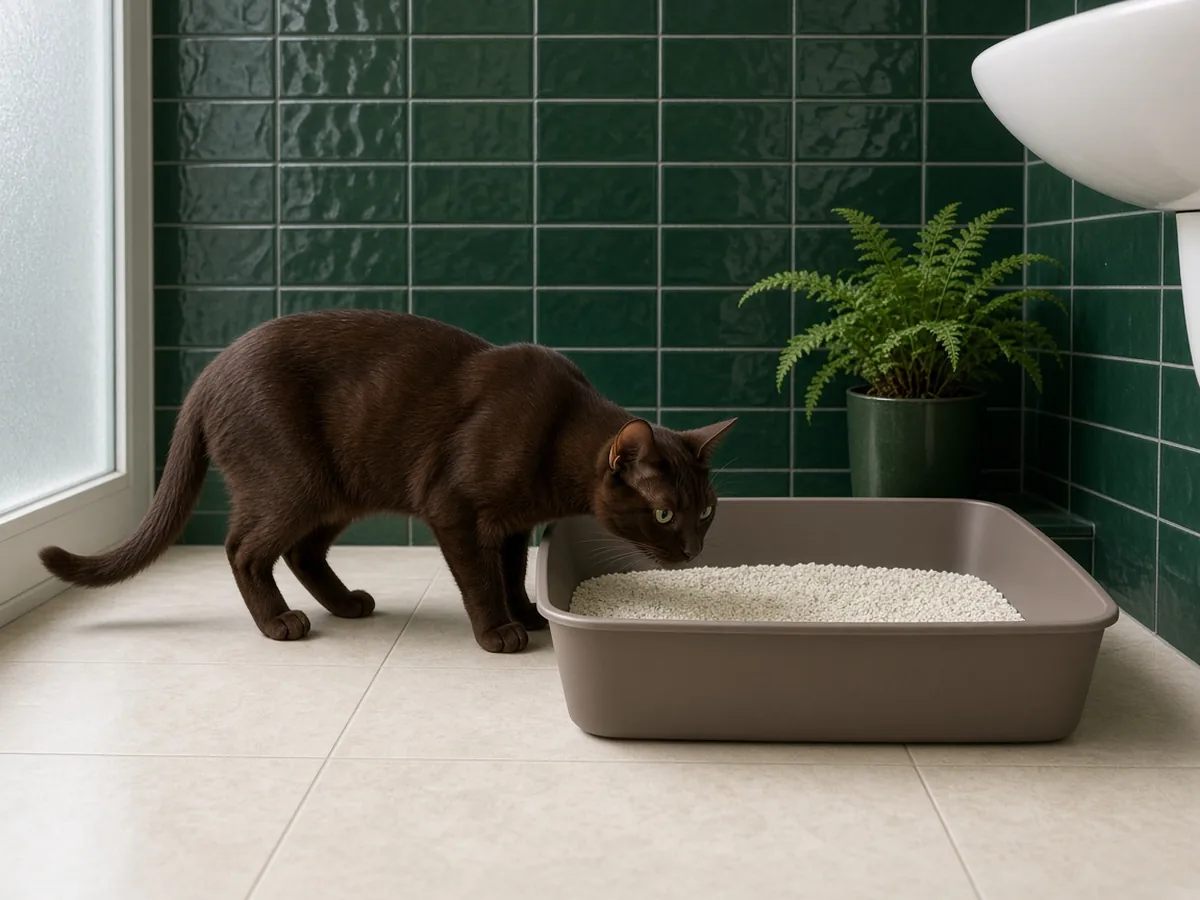
For most first-time owners, an open, high-sided tray is the calmer first purchase. The cat can see out, there is no lid to learn, and you can scoop without a mechanism in the way.
Modkat’s Tray is a high-sided open box with a walk-off platform at the front and a clip-on splash guard at the back. Official dimensions are 20.3 × 14.0 × 9.0 in (51.0 × 36.0 × 23.0 cm). With the guard fitted, official height is 15.75 in (40.0 cm). The official entry is 8.25 in (21.0 cm) wide and 6.5 in (16.5 cm) from the floor, and the empty box is listed at 5.0 lb (2.3 kg). The page describes a seamless base, a Type G reusable tarp liner, and a hanging scoop in the box.
Those numbers are what make it useful in a small bathroom: a modest width, a low step, and extra height where urine and kicked litter usually escape. It is still a tray, not an invisible piece of furniture. It needs a mat, and it needs scooping. Official copy also markets it as “the deepest litter tray on the market”; we have not compared every tray, so treat that as the maker’s claim.
On 30 November 2026 (HKT), Modkat’s official store listed the Tray at US$59.99. The same day, Amazon.sg listed the Gray tray at S$119.39, in stock. That listing is on Amazon International Store: it ships from and is sold by Amazon Japan, and postage is shown at checkout. The Amazon title on that listing was mistranslated as “Modkat Letter Tray, Gray”; confirm it is the Gray Tray, and confirm the live price, stock, and delivery cost before you buy. A White Tray listing was not found in that check. Also confirm that the official store will ship to you — the official page we opened did not state shipping to Singapore, Hong Kong, or Malaysia.
Modkat top-entry — when tracking and floor space come first
If pellets already travel from the box to the bed in a few steps, a top-entry cube is the usual next idea. The lid is a walk-off surface on the way out, the box looks less like a tray, and many dogs cannot help themselves to the contents. The cost is jumping and turning in a smaller chamber, and a lid that holds humidity if you scoop late.
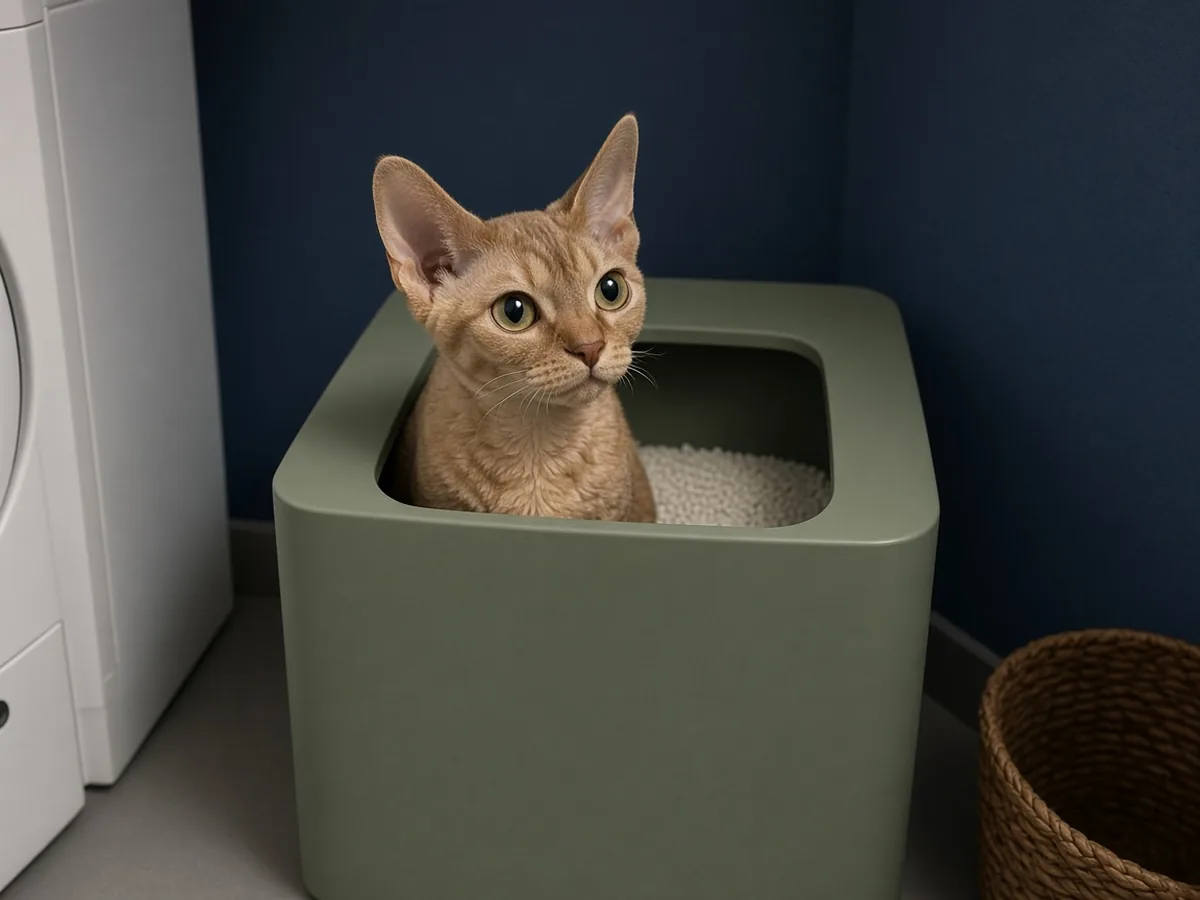
The original Modkat is a 16.0 × 16.0 × 15.0 in (40.6 × 40.6 × 38.0 cm) cube. Official details include a 9.5 in (24.1 cm) top opening, a 10 in (25.4 cm) liner height, a 6.5 lb (3.0 kg) empty weight, a swivel lid that the maker says supports up to 30 lb (13.6 kg), a seamless base, a Type A reusable liner, a hanging scoop, and an odour-filter holder with a two-pack of filters. Official guidance is that it is great for, and best suited to, cats up to 12 lb (5.4 kg); a FAQ on the same page uses “12lbs (5.5kgs).” Use 5.4–5.5 kg as the maker’s band, and be cautious with a longer or less athletic cat even inside that weight.
Modkat’s own setup advice is practical: put the new box where the old one was, fill the liner with 3–4 inches of litter, and add at least one scoop from the previous box. If your cat will not jump, or is older or recovering, this is the wrong shape — look at the open Tray, or at Modkat’s other front-entry models, rather than hoping the cat will learn a leap it cannot make.
On 30 November 2026 (HKT), Modkat’s official store listed this box at US$109.99. The same day, Amazon.sg listed the White compact top-entry model at S$168.50, in stock. That listing is on Amazon International Store: it ships from and is sold by Amazon Japan, and postage is shown at checkout. The Amazon.sg button below is for this White top-entry cube only, not the Tray, XL, or Flip. Confirm the model, colour, and the live price, stock, and delivery cost before you buy.
Best automatic litter box for apartments
A large automatic unit is not a day-one buy. A self-cleaning box can make sense later, if you already know your cat will use a contained box, you can spare a large rectangle of hard floor plus clearance, you will still empty a waste drawer and wash the cylinder, and you would rather spend money than scoop daily. It is a poor first-week purchase if you are still introducing a kitten, you only have a narrow bathroom, or you hoped the machine would disappear as a chore.
Odour, night-time cycle noise, and the real size of the machine are the tests that matter in a compact flat. Daily scooping of a simple tray still does most of the odour work; a carbon filter or an “odour” cycle is a supplement, not a licence to ignore the drawer.
PETKIT Purobot Max 3 — only if the machine actually fits your life
PETKIT’s official Purobot Max 3 page lists model P9906, overall dimensions 24.4 × 21.2 × 21.7 in (620 × 538 × 552 mm), an entrance height of 8.03 in (204 mm), and a unit weight of 22 lb (10 kg). Official suitability is cats 6 months and older, weighing 1.5–10 kg (3.3–22 lb). The same page also uses broader marketing language (“all breeds and ages”); the numbered limits are the ones to use. Power is officially 12 V, 2 A, 24 W, with 2.4 GHz Wi-Fi for the app. Official capacities are a 76 L cylinder and a 7 L side waste bin, which PETKIT says can go up to 15 days in a single-cat home, with actual results varying.
Those dimensions are the honest apartment test. This is not a slim tray. You need a hard, level floor — several reviews on the official page say weight sensing misbehaves on carpet — and you should confirm socket, voltage, and plug type for your city, because the official page we opened did not spell out adapters for Singapore, Hong Kong, or Malaysia. Official litter guidance is that it works with “99% of clumping litters including clay, tofu, corn, and bentonite-based options,” with interchangeable standard and honeycomb sifters in the box, and a comparison table that limits clumping litter to 12 mm in length and 3 mm in diameter. That is the maker’s compatibility claim, not a test we ran. Official English pages for pidan tofu litter still do not spell out automatic-box use, so the box manual and the bag in your hand are the documents that matter.
Safety features on the official page include 12 sensors that PETKIT says will stop the cylinder if a cat enters mid-cycle, and an incomplete gear so a permanent opening remains even with no power. Those are design claims we have not independently tested; follow the manual, use kitten or maintenance modes if the maker provides them, and do not leave a young kitten with a cycling machine unattended just because the copy is reassuring. App health alerts are information, not a diagnosis. A sudden change in urination still belongs with a veterinarian.
PETKIT describes 35 dB operation as “whisper-quiet.” We have not measured it. In a studio, assume you will hear a cycle at night until you know otherwise, and use any scheduling controls to avoid the hours you and your neighbours care about most.
On 30 November 2026 (HKT), PETKIT’s official store listed the Purobot Max 3 at a sale price of US$375.99, with a regular price of US$499.99. No end date for the sale was visible on the page we opened, so confirm the live price before you buy. The same page said the store cannot deliver to PO Boxes; it did not clearly state shipping to Singapore, Hong Kong, or Malaysia.
How to live with a box in a small flat
Put a tight mat under whatever you buy, and keep a scoop, bags, and a sealed bin next to it so you are not crossing the flat with an open clump. In a walk-up, take waste down regularly rather than leaving a full bag in a hot kitchen. Follow your building’s rubbish rules; if you use a chute, bag clumps securely. Do not default to flushing — the litter guide explains why that is not a simple yes.
In humid weather, store spare litter sealed and off a damp floor, and do a full empty sooner if a freshly scooped box still smells. Wash reusable liners or trays as the maker directs, and dry them thoroughly; a damp liner in a closed bathroom is an odour source of its own.
If you add a second box, put it in a different path, not beside the first one. Two boxes in the same corner behave like one box with extra plastic.
Where to buy, and what to check
Start with the official product page so the model name, liner type, and — for a machine — the sifter and weight limits are correct. Then look for current stock on the brand’s regional store, a local pet shop, or a tagged Amazon.sg listing if the same product is available there. We do not invent listing codes or promise that a colour or a liner pack is in stock in your city.
On a 30 November 2026 (HKT) check, Amazon.sg listed the official Modkat Tray in Gray, and the official compact top-entry Modkat in White. Both listings were on Amazon International Store, with postage shown at checkout — the Tray listing and the top-entry listing both ship from and are sold by Amazon Japan. Confirm the model, colour, and the live price and stock before you buy. A White Tray listing was not found in that check. The Purobot Max 3 had no Amazon.sg buy button in that check; use the official store link for that model.
Before you pay for a self-cleaning box, confirm voltage and plug, spare bags and filters, and the litter you already use. An official US or global store is not a guarantee of local service.
FAQ
How many litter boxes do I need in a studio?
The useful rule is one per cat, plus one extra if you can spare the floor. AVS states that idea for multi-cat homes. If you only have room for one, make it large enough for the cat to turn around, scoop more often, and do not hide it behind a door the cat will not push.
Should I buy an automatic box for a kitten?
Not as the only box, and not before you have read the maker’s age and weight limits. PETKIT’s official suitability line for the Purobot Max 3 is 6 months and older, and 1.5 kg and up. A young kitten needs an easy entry and a box you can supervise. Keep a simple open tray available.
Will a covered or top-entry box stop the smell?
It will hide the tray and can reduce scatter. It will not replace scooping. In a warm, humid bathroom, a lid can hold odour in until you open it. Scoop daily anyway.
My cat stopped using the box after I changed it. What should I do?
Put the old setup back, or something close to it, and change more slowly. If the cat is straining, going more often, crying, or urinating outside the box after previously being reliable, contact a veterinarian rather than buying a new scent of litter.
Can I put the box on a balcony to save indoor space?
We would not, in this climate. A balcony is hot, it gets wet, and it is an easy place for a cat to slip out. Keep the box indoors, on a mat, where you will actually scoop it. If you also have openable windows or a balcony door, read our guide to cat-proofing windows and balconies in a high-rise, and do not treat a balcony as a litter room.
Verdict
Start with the box your cat will enter and you will scoop, not with the most automatic object you can plug in. In many compact flats, the Modkat Tray is the more honest first purchase: low entry, high sides, no app. If tracking or a visible tray is the main problem, and your cat is within the official size band and can jump comfortably, the compact top-entry Modkat is a reasonable next step. Leave the Purobot Max 3 — or any other self-cleaning cylinder of this size — for the household that has already measured the floor, accepted the price and the running costs, and is willing to empty a drawer and clean a machine. The litter you put in it still has to be one the cat will use, and one the box can actually sift.
This page includes affiliate links. As an Amazon Associate I earn from qualifying purchases. See our affiliate disclosure.
Related guides
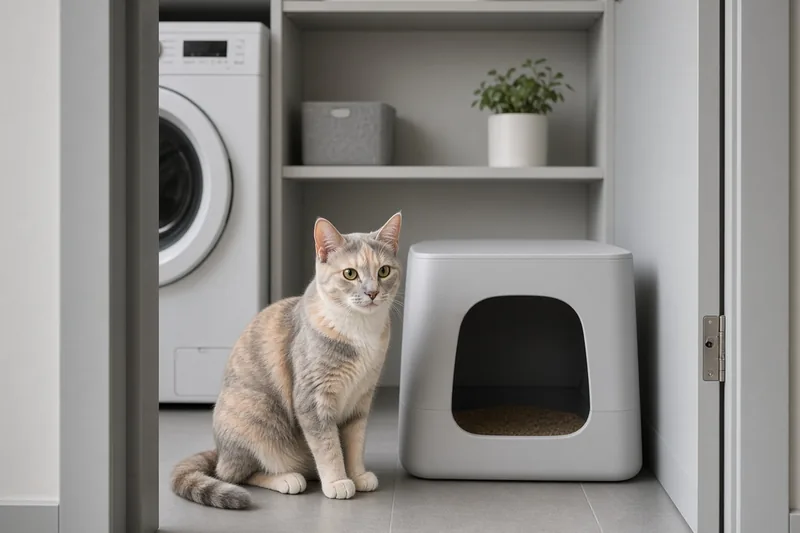
Best cat litter for small apartments
How to choose cat litter for a small home, with an honest look at tofu pellets, corn clumping litter, odour, tracking, and why “flushable” is not a simple yes.
Read the guide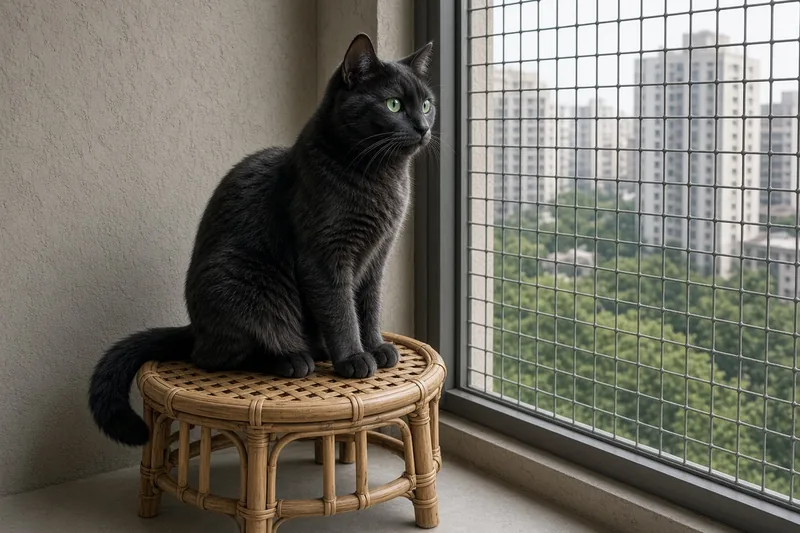
How to cat-proof windows and balconies in a high-rise
How to cat-proof windows and a balcony in a high-rise: why ordinary mosquito screens are not enough, what official sources ask for, and how to get a made-to-measure net.
Read the guide
Best cat water fountain for apartments
A practical shortlist of apartment-friendly cat fountains — Catit, PETKIT, and PETLIBRO — with noise, splash, and cleaning first, and no invented tests.
Read the guide